
Akai MPC Sample Review: The $399 Portable Sampler That Brings Back the Classic MPC Workflow
No laptop, no menus inside menus. Sample it, chop it, play it. Akai’s smallest MPC is built around the part of beatmaking that made the MPC famous.
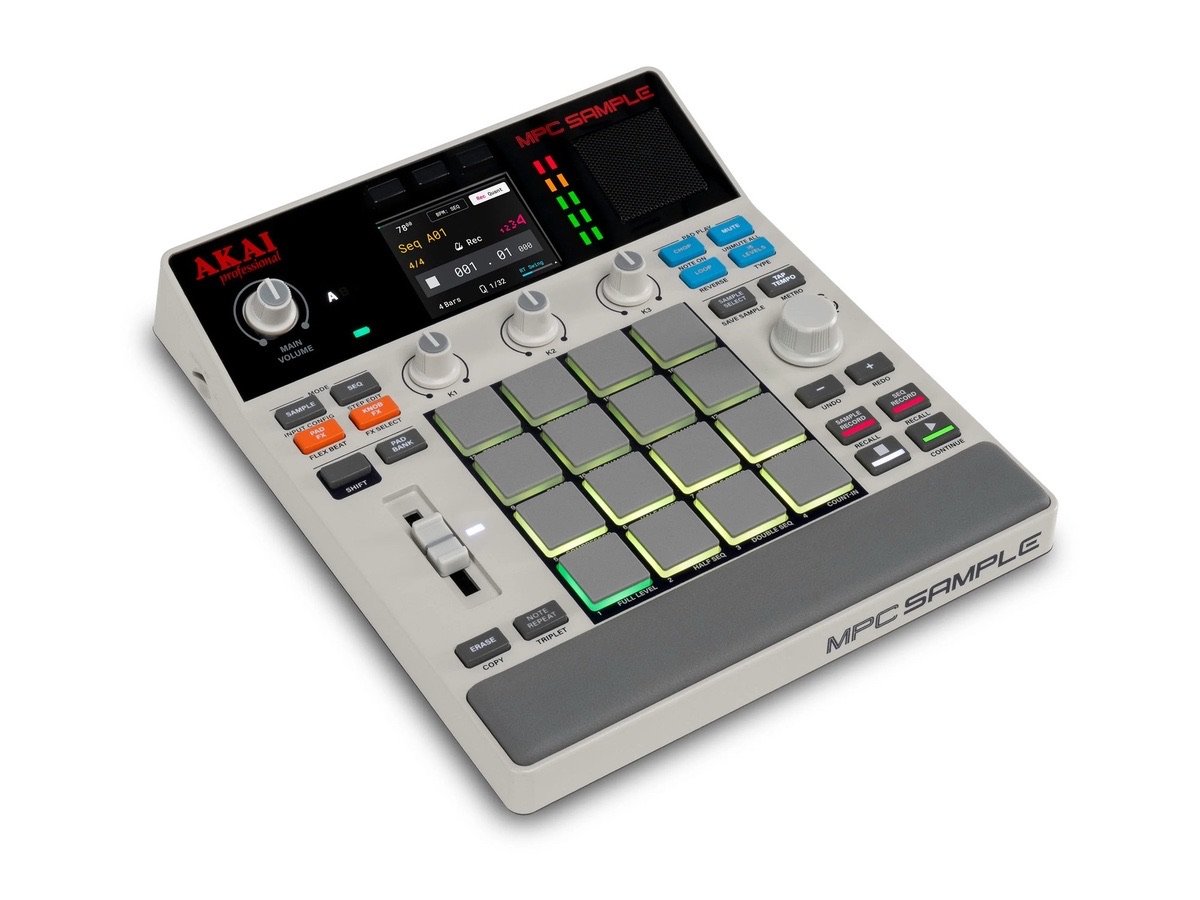
For most of the last decade, every new MPC has tried to do more: more tracks, more plugins, more screens, more menus. The Akai MPC Sample goes the other way. Released on March 24, 2026 at $399, it is a battery-powered, standalone sampler that strips the MPC back to the loop that built hip hop production: find a sound, chop it across 16 pads, and play it with swing.
Its gray chassis and red logo are a deliberate nod to the MPC60 and MPC3000, the machines behind a generation of boom bap records. The idea is the same too. It is not trying to replace your DAW or the flagship MPC Live. It is a sketchpad you can throw in a backpack.
What is the Akai MPC Sample?
The MPC Sample is Akai Professional’s most compact and affordable standalone MPC. It samples from its line inputs, from a built-in microphone or from files, slices the audio automatically, and sequences full songs, all without a computer. A 3-watt speaker and a rechargeable battery mean you can literally make a beat on the couch, on a train or in a record store.
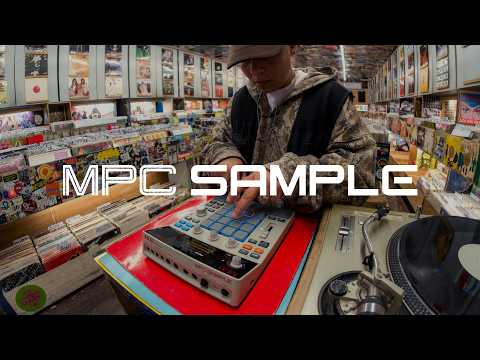
Akai’s own tagline for the launch was “Where Beats are Born”, and the official video below shows the concept in about a minute.
Akai MPC Sample specs
| Pads | 16 RGB, velocity-sensitive with polyphonic aftertouch |
|---|---|
| Polyphony | 32 stereo voices |
| Memory / storage | 2 GB RAM · 8 GB internal (about 2 GB of factory content) · microSD slot |
| Project size | Up to 128 samples (8 banks × 16 pads) and 128 sequences |
| Screen | 2.4" full-color display with waveform view |
| Controls | 3 knobs, 1 assignable fader, data encoder |
| Effects | 60 effect types across Pad FX, Knob FX, Flex Beat and a color compressor |
| File formats | WAV, AIFF, MP3, FLAC, OGG |
| Built-in | Microphone · 3 W speaker · rechargeable lithium-ion battery (5–6 hours) |
| Connections | ¼" TRS line in and out · 3.5 mm headphones · MIDI in/out (3.5 mm TRS) · sync out · USB-C |
| USB audio | Works as a 2-channel audio interface |
| Size | 23.6 × 19.4 × 5.0 cm (about 9.3 × 7.6 × 2 in) |
| Factory content | 100+ drum kits |
The workflow: sample, chop, sequence
This is where the MPC Sample earns its name. Press sample, hit a pad, and you are recording, from a turntable plugged into the back, from your phone, or from the room through the internal mic. Instant chop mode slices a loop across the 16 pads automatically, so a break becomes a playable kit in seconds.
Samples can be repitched and timestretched in real time, and you can resample internally, running a sound through an effect and capturing the result as a new sample, the old-school way of building texture. Classic MPC tools such as pitch and velocity spread across pads are there, and reviewers single out the swing as one of the best-implemented parts of the machine. That matters: swing is half of what people mean when they say a beat “feels like an MPC”.
Songs are built from up to 128 sequences, and since firmware 1.2 you can turn a finished song back into an editable sequence to keep working on it.
Effects and sound
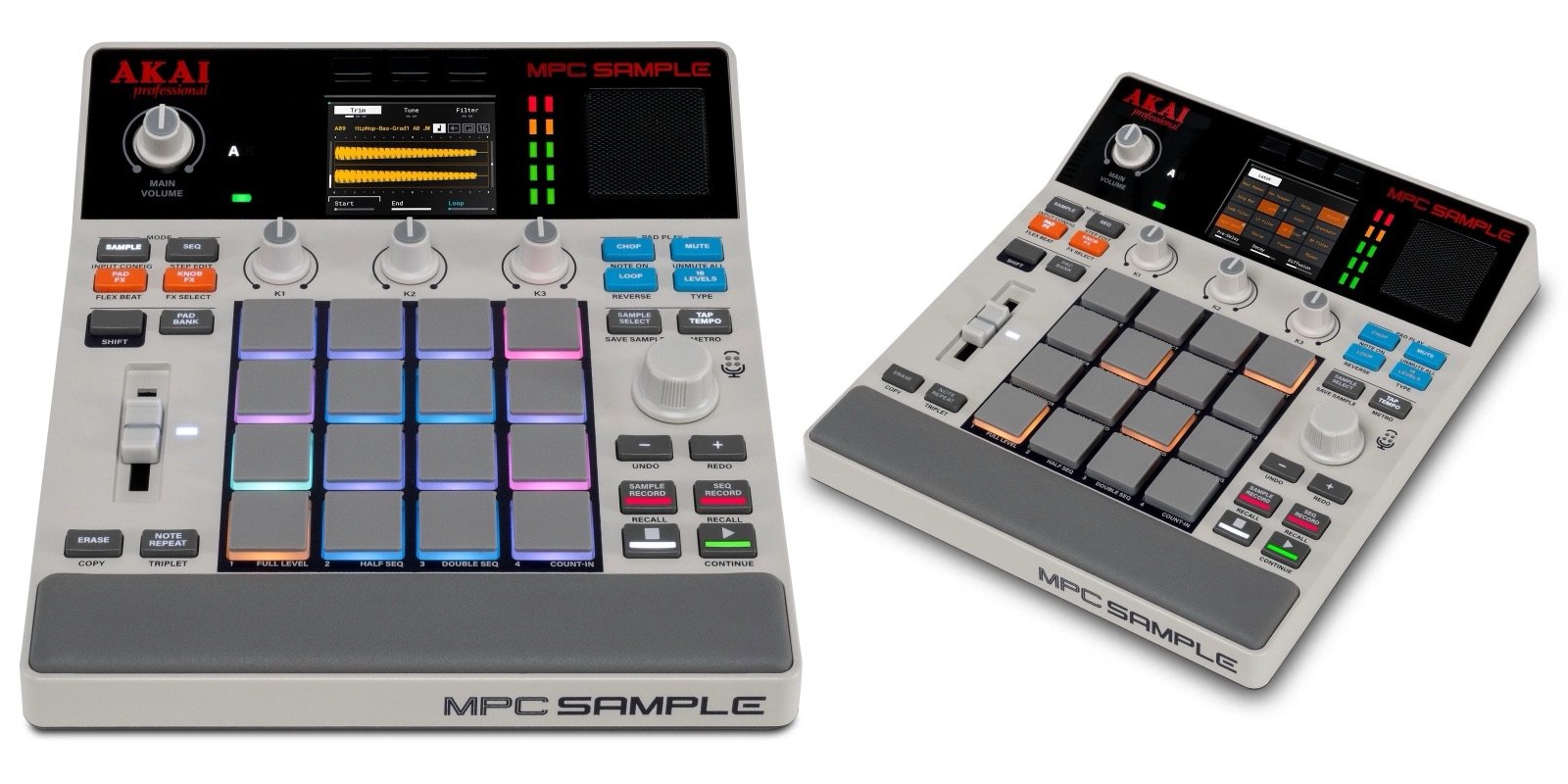
There are 60 effect types spread across four engines: Pad FX (performance effects triggered from the pads), Knob FX, Flex Beat (beat-repeat and rhythmic mangling) and a color compressor for glue and grit. For live tweaking they are fun and immediate.
The catch is routing. Effects are designed for performance, not mixing: you cannot record a different effect on every sound, so the classic workaround is to resample the processed sound. If you come from the Roland SP-404 MKII, with its multiple simultaneous FX buses, this is the biggest adjustment.
Connectivity: small box, real I/O
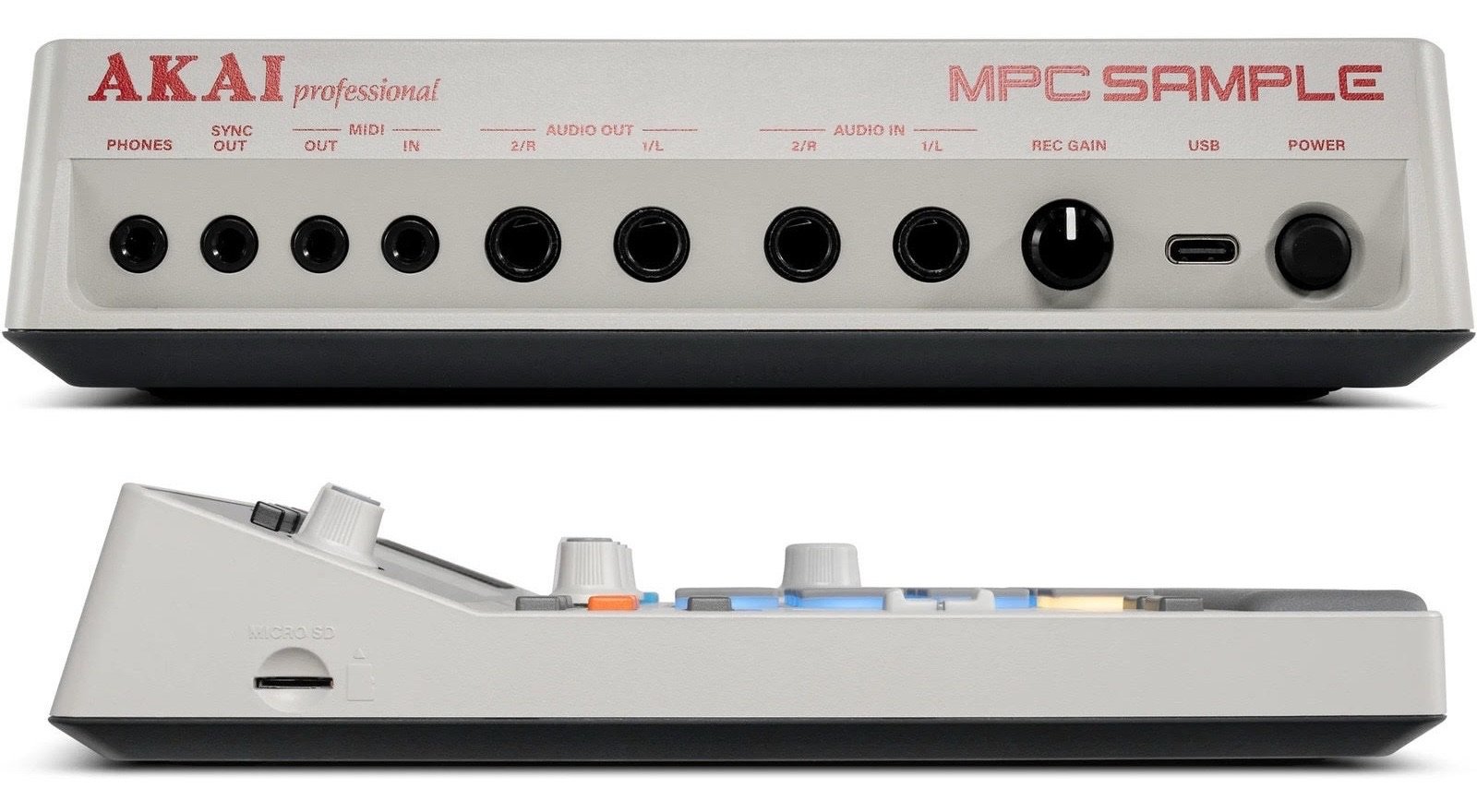
Unlike many pocket samplers, the MPC Sample uses quarter-inch balanced line inputs and outputs, so it plugs straight into a mixer, an interface or a turntable preamp without adapters. It also has MIDI in and out and sync out to drive other gear, a headphone jack, a microSD slot for more storage and USB-C for power, file transfer and audio.
Firmware updates since launch
Akai has kept the MPC Sample moving since March:
- Firmware 1.2 / 1.2.1: SD card access without removing the card, Export Song to Sequence, Loop Lock per pad and improvements to saving and disk streaming.
- Firmware 1.3 (April 13, 2026): Normalize Sample and knob takeover modes (Pickup, Scaled and Instant) for the standard knobs, Knob FX and the fader.
Projects made on the MPC Sample open in MPC 3.8 software and newer MPC hardware, so a sketch started on the couch can be finished on a bigger rig. The reverse is not supported.

MPC Sample vs SP-404 MKII vs EP-133 K.O. II
These are the three portable samplers most beatmakers are comparing right now. Here is how they line up on the points that matter:
| Akai MPC Sample | Roland SP-404 MKII | TE EP-133 K.O. II | |
|---|---|---|---|
| List price (US) | $399 | $499 | $299 at launch |
| Strength | MPC pad feel, swing, song sequencer | Effects routing, build, maturity | Playful design, tiny footprint |
| Memory | 2 GB RAM + microSD | SD card based | 128 MB |
| Effects | 60 types, one at a time per performance | Multiple simultaneous FX buses | Basic punch-in FX |
| Weak spot | Light build, basic timestretch | Higher price, less refined velocity | Limited memory and screen |
The short version: the SP-404 MKII wins on effects and durability, the EP-133 wins on price and fun, and the MPC Sample wins on feel, immediacy and sequencing. If your music lives on chopped samples and swing, the MPC is the natural fit.
The downsides
- Timestretch is basic. Several reviewers found it rough on some material.
- No stem export. There is no direct way to bounce individual tracks for a DAW.
- Effects are performance tools, not a mixing section. Resampling is the workaround.
- Lighter build than the SP-404 MKII, and more prone to cosmetic wear.
- Not a controller for MPC 3 software, and MPC 3 projects can’t be loaded onto it.
- Availability. It sold out right after launch and stock has been patchy in some stores.
A producer’s take: who is it for?
The MPC Sample makes the most sense for producers who start beats from records and sounds rather than from presets. Sampling a loop, chopping it and finding the pocket with swing is the whole job here, and the machine keeps everything else out of the way. That makes it a strong first MPC for new beatmakers, and a second machine for producers who already own a big rig but want to sketch away from the desk.
It is not the tool to mix and master a record. But for catching an idea while it is still alive, $399 is a very reasonable price for the most direct MPC Akai has made in years.
Akai MPC Sample FAQ
How much does the Akai MPC Sample cost?
It launched at $399 in the US and €399 in Europe on March 24, 2026.
Does it need a computer?
No. It is fully standalone: it samples, chops, sequences and runs on battery with a built-in mic and speaker. A computer is only needed for firmware updates or moving files.
How long does the battery last?
Akai quotes five to six hours from the rechargeable lithium-ion battery, which charges over USB-C.
Can it work as an audio interface?
Yes, over USB-C it works as a 2-channel audio interface.
Can I open MPC Sample projects in MPC 3?
Yes, in MPC hardware and software running version 3.8 or newer. MPC 3 projects can’t be loaded on the MPC Sample.
Is it better than the SP-404 MKII?
It is cheaper and has the classic MPC feel and sequencer. The SP-404 MKII has deeper effects routing and a sturdier build. It depends on whether you sequence songs or perform with effects.
Sources
- Hispasonic: Akai MPC Sample, un sampler de los 80 para la era moderna
- Akai Professional: MPC Sample FAQ
- MusicTech: Akai MPC Sample review
- MusicRadar: Akai MPC Sample review
- CDM: MPC Sample firmware updates
- Gearnews: How and why the MPC Sample broke the internet
- Lofi Weekly: SP-404 MKII vs MPC Sample
Product photos and videos: Akai Professional. GUIO Records is not affiliated with Akai Professional.